A second iPhone running Verana can act as a monitor and controller for the first. One device is set to the camera role and holds the lens. The other is set to the monitor role, shows what the camera sees, and drives its exposure, white balance, focus, lens and shutter from across the room. Both devices need to be on the same local network.
The monitor screen is assembled from the same parts as the camera screen: the same viewfinder, toolbar, Mode button, main dial, lens switcher, shutter button, bottom bar and landscape relayout. Chapter 2 describes all of them and remains the description. This chapter covers only what the monitor does differently, then the two accessory routes that extend the camera itself: Bluetooth controllers and HDMI output.
21.1 The Two Device Roles
A device is either the camera or the monitor. The role is chosen on DEVICE ROLE, which
offers CAMERA and MONITOR, and the app rebuilds around the choice as soon as you make
it. The camera role is the normal application. The monitor role captures nothing of its
own: there is no sensor running behind that screen, only the image arriving from the
camera.
Where to change it: Settings → Remote Control → iPhone.
The role is remembered between launches, so a phone kept as a dedicated monitor stays one until you change it back.
21.2 The Local Network Permission
Remote monitoring depends on the two devices being able to reach each other, which iOS gates behind the Local Network permission. Until that permission is granted, nothing in this section of the chapter works.
The LOCAL NETWORK section on the same page reports where you stand and offers the one
action that will move you forward. Before you have ever used the feature it shows
ENABLE REMOTE CONTROL. Tapping it turns remote control on and raises the system prompt.
Answer yes and the section disappears, since there is nothing left to set. Answer no and
the section stays, now explaining that access is off and offering OPEN SETTINGS, which
takes you to Verana’s page in the Settings app where the Local Network switch lives.
Return afterwards and the connection resumes by itself.
iOS asks for this permission once and provides no way for an app to ask again, which is why a refusal is answered with a route into system settings rather than a second prompt.
Note: the prompt is raised by the button, not by opening the page. A camera also becomes visible to monitors only once you have enabled remote control on it, and it stays visible at every launch afterwards. A phone that has never had remote control enabled announces nothing.
21.3 Connecting
The CONNECTION section reports the state of the link in plain words: Disconnected,
Searching…, Connecting…, or Connected to and the name of the other device. The
monitor screen carries the same reading in a bar directly below the toolbar, so the state
is visible while you are working rather than only in settings.
When a monitor finds a camera, the camera asks its operator before anything is shown. An
alert headed Connection Request names the monitor and states what it will be able to
do, with Accept and Refuse beneath. A request nobody answers is refused after a
minute. Work with one enabled camera at a time. If the connection drops, both devices
return to looking for each other and reconnect on their own.
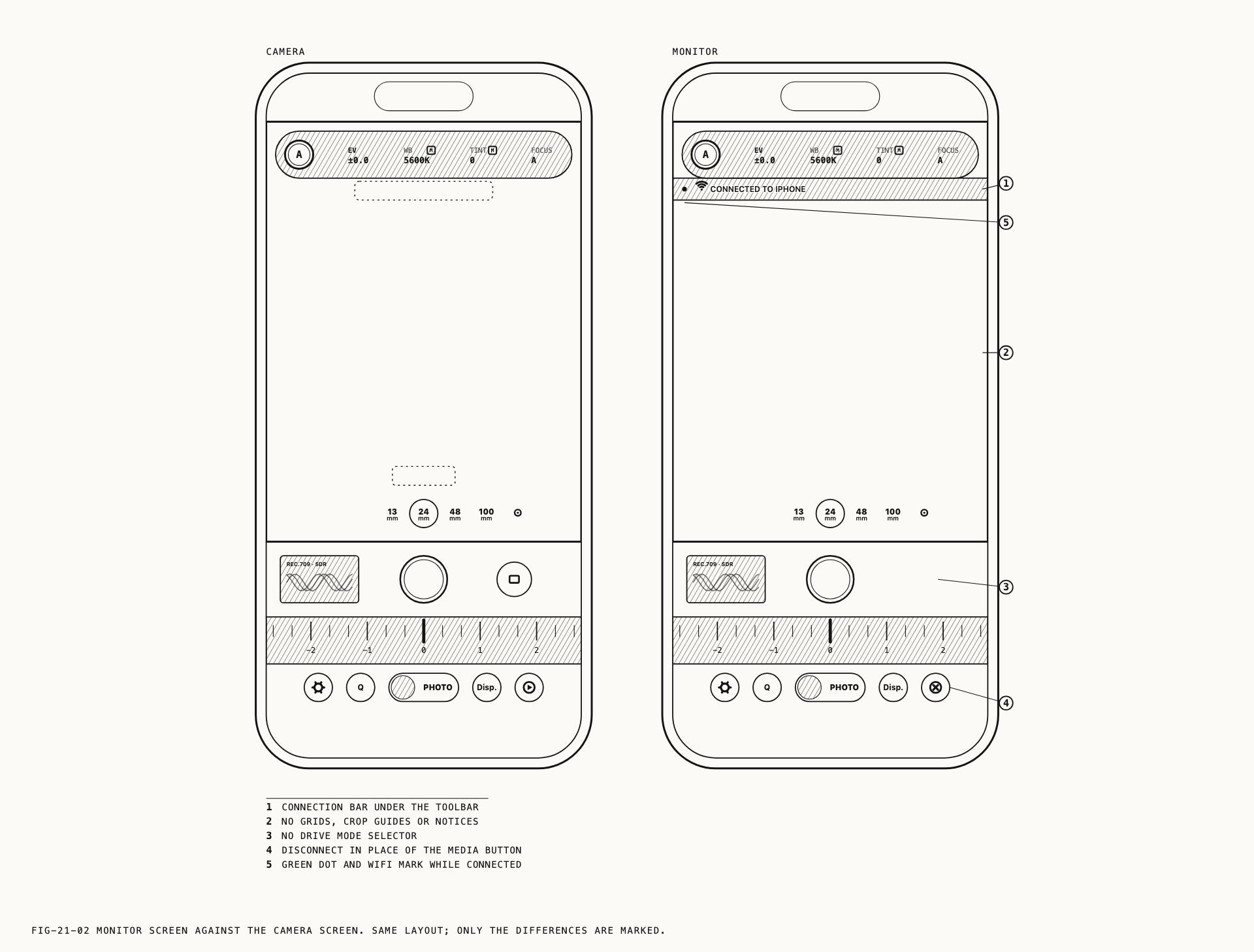
21.4 What the Monitor Screen Does Differently
The monitor screen shows the camera’s monitoring image. Everything carried in that image arrives with it: the color treatment currently selected, monitor color, focus peaking, false color, image flip and anamorphic desqueeze. Everything drawn by the camera’s interface on top of the image does not. Composition grids, crop guides, the level, the viewfinder indicators and the notices are all camera-side, so the monitor shows a clean feed.
That last omission has a consequence for anyone leaving the camera unattended. Notices report dropped frames, full storage and failed sequences, and they appear on the camera only. A condition that stops a take is not announced on the monitor.
Mode button and toolbar. The Mode button mirrors the camera’s exposure mode and
cycles A, M and S when tapped, hiding and showing tools exactly as it does on the
camera. The custom mode positions on its long press are not offered from the monitor.
Exposure modes are covered in Chapter 3.
Main dial. The same six tools are on the dial and each turn is sent to the camera, which applies it and reports back. The values you read are the camera’s, not a local guess.
Lens switcher. Lenses, focal length options and the press-and-hold zoom slider all work from the monitor and drive the camera’s lens.
Shutter button. The monitor captures single frames and starts and stops recording. Burst, the intervalometer and the self-timer are camera-side and have no monitor control, so the drive mode selector is not shown.
Status line. The recording timer appears while the camera is recording. The burst count and interval run readout have nothing to report here.
Bottom bar. The media button is replaced by a disconnect control. Tapping it ends the session and returns the device to the camera role, which is also how a monitor becomes a camera again without going through settings. Settings itself is reached as usual.
The teleprompter is not shown on the monitor. A script runs on the device holding the camera, where the person reading it is looking. Chapter 12 covers the prompter.
The monitor keeps its screen awake for as long as the monitor screen is showing, so a phone left on a stand does not sleep mid take.
The quick menu and the display mode act on the camera and are not offered from the monitor.
21.5 Focus From the Monitor
Tapping the monitor’s image places a focus point on the camera, and the whole of the
camera’s focus behavior comes with it. The tap is not a separate feature with its own
rules: it runs the same path a tap on the camera’s own viewfinder runs, so Tap Action
and Tap Behavior govern it, a long press latches focus and exposure where the setting
allows, and the point is released the same ways. Chapter 5 covers all of it.
Three consequences follow, and they matter because the settings live on the camera while you are holding the monitor.
With Tap Action set to Off, taps on the monitor are ignored, exactly as they are on
the camera. With Long Press: AF/AE Lock turned off, a long press on the monitor does
nothing. And during an intervalometer run, focus is locked for the whole run, so a tap
from the monitor is refused; the notice explaining why appears on the camera, where the
notices are.
The focus point is drawn on the monitor as it is on the camera, through the same states,
and the lock chip reads AF-L or AF/AE-L according to what is actually held.
21.6 Bluetooth Controllers
Verana connects to a Tilta Nucleus-M follow focus over Bluetooth. The handwheel drives the lens and the controller’s record button starts and stops video recording.
Where to change it: Settings → Remote Control → Bluetooth.
The Bluetooth toggle at the top of the page turns the feature on, and turning it on for
the first time raises the system Bluetooth permission prompt. Until then the page reads
Enable Bluetooth to connect to devices. If the radio is switched off at the system
level the page says so with Bluetooth is turned off in system settings. and waits.
With the feature on, Verana scans for controllers as soon as the radio is available and
lists what it finds under TILTA NUCLEUS-M. A scan runs for ten seconds and then stops,
and SCAN FOR DEVICES runs another. While one is in progress the same button reads
STOP SCANNING. When nothing has been found the page reads
No Nucleus-M found. Power the controller on and scan., and once a controller is listed
it reads Tap a device to connect or disconnect. Scanning stops on connection. There is
no automatic reconnection, so a controller that has been powered down is reconnected the
same way it was connected.
The handwheel sets focus distance directly and takes ownership of focus as the FOCUS
dial does, which means a tapped focus point is cleared the moment the wheel moves.
Turning the wheel and tapping the viewfinder are two ways of claiming the same control,
and the most recent claim wins.
The record button starts and stops video recording. In photo mode it is ignored.
Bluetooth controllers connect to the device holding the camera. A phone in the monitor role has no lens to drive.
21.7 HDMI Output and Clean Output
A display connected over HDMI or over AirPlay normally mirrors the whole screen,
interface included. HDMI Out replaces that with the viewfinder image alone.
Where to change it: Settings → Monitoring → HDMI.
With the toggle on and a display attached, the external screen shows the camera’s monitoring image and nothing else, fitted to the display and centered on black. It carries the same color treatment the viewfinder carries, so what a client sees on a set monitor matches what you see on the phone. No part of the interface is ever drawn there. With the toggle off, the display mirrors the screen as the system would without Verana involved.
The STATUS line reports what is actually attached: No external display connected.,
External display connected. when a display is present but the toggle is off, and
External display connected. Clean feed active. when the clean feed is running.
The output follows the camera. A phone in the monitor role does not drive an external display.